A philosophical worldview or belief system grounded on the 20th century discovery that Information, rather than Matter, is the fundamental substance of everything in the universe. It is intended to be the 21st century successor to the ancient worldviews of Materialism and Idealism. An Update from Bronze Age to Information Age. It's also a Theory – of – Everything that covers, not just matter & energy, but also Life & Mind & Love.
Post 149.December 19, 2025
BothAnd vs Either/Or Philosophy
Practical Wisdom vs Theoretical Ideals
I coined the term BothAnd for my thesis and blog in order to label my personal alternative to the binary Either/Or mindset of some perfectionists, who find the uncertainties, complexities & contradictions of the world confusing and disappointing. I didn’t know that Søren Kierkegaard had already applied that term to a completely different, ethical-vs-aesthetic, per-spective. My philosophy is comparable to the holistic principle of complementarity, as illustrated in the ancient Yin-Yang¹ symbol [], and as exemplified in 20th century Quantum physics.
The BothAnd philosophy² requires holistic spectrum thinking instead of reductive & exclusive, black/white, & all-or-nothing reasoning. It assumes that the thinker has no privileged god-like perspective on the world, but instead, a private relative point-of-view. So, its conclusions are not absolute Either/Or³, but more like probable Bayesian⁴ beliefs. Yet, why would anyone prefer the uncertainty of Probability (maybe-maybe not) to the confidence of two-value (either/or) reasoning? Some philosophers aspire to a complete & perfect Ideal model of the world, but others are content to construct a more realistic interpretation of the data & facts available to human observers.
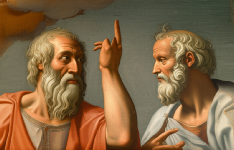
For example, early Catholic theologians accepted the ancient Greek philosophers — Plato & Aristotle — as their mentors. Hence, they also made a moral distinction between Socratic true/false reasoning, and Sophist pragmatic methods. Yet, that implicit contrast in thinking styles may have been influenced by the ecclesiastic desire of the imperial church to inspire dogmatic unquestioning Faith. So, they represented Sophistry as fallacious and deceitful, like the wiles of Satan.
From a more modern perspective though, the secular Sophists may have anticipated Albert Einstein’s 20th century scientific & philosophical principle of Relativity⁵. It was based on actual real-world Earth-bound observations instead of the idealized interpretations of Isaac Newton’s divine mechanics. Yet, while Socrates may have aspired to perfect Ideal under-standing, his intellectual humility admitted that he knew nothing for certain. So, in the real world, the Sophist’s “practical wisdom” may be more valuable to ordinary humans for dealing with mundane questions and problems.
Plato’s disparaging description of the Sophists was similar to the Catholic position, in defense of their belief in a realm of super-natural gods & ideal Forms, and in disparagement of the imperfec-tions of the Real material world. But since we live & breathe in a still-evolving and incomplete reality, our Practical Wisdom is what we call Secular Science. Even Aristotle favored the virtue of knowing the right thing to do in specific situations : Phronesis.
1. The Yin-Yang principle A core concept in Chinese philosophy describing how opposite, interdependent forces (Yin: dark, passive, feminine; Yang: light, active, masculine) create a dynamic, harmonious whole, emphasizing that nothing is absolute, everything changes, and each force contains the seed of the other, teaching balance, flow, and acceptance of duality in nature, health, and life. https://www.google.com/search?client=firefox-b-1-d&q=yin+yang+principle
2. BothAnd-ism : An inclusive philosophical perspective that values both Subjective and Objective information; both Feelings and Facts; both Mysteries and Matters-of-fact; both Animal and Human nature. https://blog-glossary.enformationism.info/page10.html
3. Either/Or worldview : A rigid mindset that sees the world in black-and-white terms, assuming only two possible options or extremes (like success/failure, with us/against us, this/that), ignoring nuance, complexity,
Either/Or continued . . . .
First Law of Philosophy For every philosopher there is an equal and opposite philosopher
4. Bayesian Beliefs : Bayesian belief refers to the concept of representing knowledge or certainty as probabilities, which are updated using Bayes' theorem as new evidence emerges. 5. Einstein's Relativity : Einstein's relativity philo-sophy fundamentally reshap-ed our understanding of reality, asserting that space and time aren't absolute but are interconnected as spacetime, and that the laws of physics (especially the constant speed of light) and energy-mass equivalence (\(E=mc^{2}\)) are universal truths, shifting focus from fixed, absolute concepts to observer-dependent per-spectives and dynamic relationships, challenging Newtonian absolutes https://www.google.com/search?client=firefox-b-1-d&q=einstein%27s+relativity+philosophy
Post 149 Continued . . . click Next
Holistic & Complex Systems The new properties that appear during a phase transition (e.g., the rigidity of ice versus liquid water's fluidity) are examples of emergence, where the collective behavior of a large number of particles results in system-level properties that individual particles do not possess. This concept is a fundamental aspect of complexity theory, which is mathematically compatible with a materialist and deterministic framework.
Complexity theory contrasts with determinism by showing that some complex systems can have emergent properties that are not reducible to the deterministic rules of their components, and these systems may not be predictable even if they are technically deterministic.. Determinism posits that all events are predetermined by prior causes, while complexity theory suggests that phenomena like consciousness and free will could emerge in complex systems where order and randomness interact
The opposite of binary thinking (black-and-white, either/or) involves embracing complexity through Spectrum Thinking, Non-Binary Thinking, or Grey Thinking, focusing on nuances, gradations, and multiple possibilities rather than rigid categories like good/bad or right/wrong. It's about recognizing the "both/and," finding common ground, exploring the space between extremes, and seeing the interconnectedness of ideas, allowing for more flexible, nuanced solutions. https://www.google.com/search?client=firefox-b-1-d&q=binary+antonym
Boolean Logic versus Human Reasoning :
The BothAnd philosophy is an experiment, which applies the idealist implications of the Enformationism worldview to real-world quandaries that are still being debated after millennia of study by Theologians, Scientists, and Philosophers.




 BACK
NEXT
BACK
NEXT
 Forum
Forum