A philosophical worldview or belief system grounded on the 20th century discovery that Information, rather than Matter, is the fundamental substance of everything in the universe. It is intended to be the 21st century successor to the ancient worldviews of Materialism and Idealism. An Update from Bronze Age to Information Age. It's also a Theory – of – Everything that covers, not just matter & energy, but also Life & Mind & Love.
Post 150.February 1, 2026
Metaphysics of Causation
Causation is the Meaning of Change
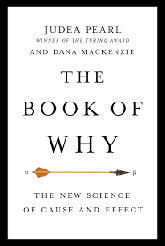
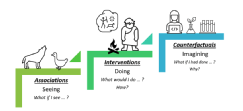
The Book of Why, by Judea Pearl, an Israeli-American computer scientist and philosopher, describes the meaning of Causation as a ladder of steps : observation, intervention, and counterfactuals. This model allows us to go beyond Hume’s dismissal of observed correlations as still snapshots, and to infer a dynamic direction, or intentional goal, implicit in a series of physical changes. Scientists can intervene (with artificial causes) in an evolving system to see what effects that novel input may have. But the researcher doesn’t have to actually tamper with the system physically, because she may simply imagine or infer, by means of counter-factual⁵ imagination, what the outcome may be.
The use of fictional Counterfactuals, in place of known facts, allows thinkers to play God : by observing as-if hypothetical scenarios to see how the dialectic of nature would play-out if & when a proposed or potential future intervention actually occurred. Thus the presumption of a lawful Logic to Nature can reveal the Meta-physics of Causation⁶. Which is also how philosophers seek answers to Why questions, in order to discover Because answers⁷.
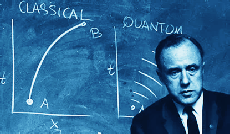
In the 20th century, Quantum-scale physics challenged the deterministic presumptions of classically-trained scientists, by introducing probabilistic outcomes to their interventions. They found, to their dismay, that the foundations of reality were causally mushy and indefinite. So they were forced to create new terminology to describe intermediate states between Cause and Effect : Superposition seems to be bothBeforeandAfter. Ironically, they observed an Indefinite Causal Order where the Cause might seem to occur after the Effect, rather than in the normal linear timeline.
They also discovered that measurements (interventions) of superposed or entangled systems would inadvertently disturb the patterns they were trying to map. Thus, raising questions of mind over matter. However, eventually, the disadvantages of Indefinite Causal Order⁸ were taken advantage of, for new avenues in quantum computing and communication. And those formerly untrod paths have led us to realize that Mental Information (knowledge) can have physical effects on the foundations of the material world, and vice-versa.
Whereas traditional, reductionist & materialist, views often argue that only physical states cause changes in the physical world, other viewpoints, including quantum-based theories, suggest a more direct, interactive role for knowledge in material reality. And the physicality of Information is now accepted, due to evidence that reality consists of quantum information (bits), where Matter and Energy are manifestations of those bits.
5. Counterfactual : Counterfactual thinking is the cognitive process of imagining alternatives to past events ("what if" or "if only" scenarios), enabling emotional regulation, causal reasoning, and future planning.
6. Metaphysics of Causation : Four general approaches to the metaphysics of causation. One is a development of the regularity theory (attributed to Hume) that uses counter-factuals. . . . A second is based in the relations of universals, which determine laws, . . . A third view, . . ., holds that a causal process is one that can be marked. This view relies heavily on ideas about the transfer of information and the relation of information to probability, but it also needs uneliminable counterfactuals. The fourth view was developed recently . . . It holds that a causal process involves the transfer of a non-zero valued conserved quantity. A considerable advantage of this approach over the others is that it requires neither counter-factuals nor abstracta like universals to explain causation. https://link.springer.com/chapter/10.1007/978-94-015-9229-1_18
Quantum Physicist John Wheeler coined the phrase “its from bits” to describe the information foundation of material reality
7. Because : The Book of Why: The New Science of Cause and Effect, by computer scientist Judea Pearl and writer Dana Mackenzie, explains the "causal revolution" that provides a scientific framework for under-standing cause and effect, moving beyond the limitations of "correlation does not imply causation". It introduces causal diagrams and a symbolic language to answer questions about what causes what, enabling better understanding in fields like medicine, social science, and artificial intelligence, and exploring "what if" scenarios. https://www.google.com/search?client=firefox-b-1-d&q=the+book+of+why
8. Indefinite Causal Order A quantum mechanical frame-work where the temporal sequence of events (e.g., event A before B, or B before A) exists in a quantum superposition. Instead of a fixed, classical timeline, operations can occur in multiple, mutually exclusive orders simultaneously, enabling advancements in quantum computing, communication, and metrology. Plus more efficient quantum information transmission.
End of Post 150
Holistic & Complex Systems The new properties that appear during a phase transition (e.g., the rigidity of ice versus liquid water's fluidity) are examples of emergence, where the collective behavior of a large number of particles results in system-level properties that individual particles do not possess. This concept is a fundamental aspect of complexity theory, which is mathematically compatible with a materialist and deterministic framework.
Complexity theory contrasts with determinism by showing that some complex systems can have emergent properties that are not reducible to the deterministic rules of their components, and these systems may not be predictable even if they are technically deterministic.. Determinism posits that all events are predetermined by prior causes, while complexity theory suggests that phenomena like consciousness and free will could emerge in complex systems where order and randomness interact
This mantra, chanted by scientists for more than a century, has led to a virtual prohibition on causal talk. Today, that taboo is dead. The causal revolution, instigated by Judea Pearl and his colleagues, has cut through a century of confusion and established causality -- the study of cause and effect -- on a firm scientific basis. https://www.amazon.com/Book-Why-Science-Cause-Effect/dp/046509760X



 BACK
NEXT
BACK
NEXT
 Forum
Forum