A philosophical worldview or belief system grounded on the 20th century discovery that Information, rather than Matter, is the fundamental substance of everything in the universe. It is intended to be the 21st century successor to the ancient worldviews of Materialism and Idealism. An Update from Bronze Age to Information Age. It's also a Theory – of – Everything that covers, not just matter & energy, but also Life & Mind & Love.
Post 150.February 1, 2026
Metaphysics of Causation
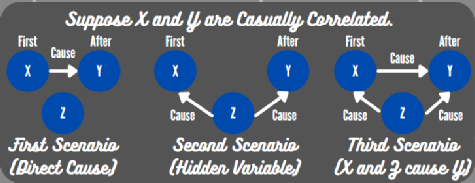
Causation is the transfer of Information
David Hume inquired into what it means for one event or thing (the Cause ; Action) to produce another similar instance in sequence (the Effect ; Reaction). And he concluded that Causation — logical relation between Cause & Effect — is merely a consistent pattern where one event follows another, rather than a necessary connection. Hume seems to suggest that causation may not be a fundamental feature of the world but rather a "folk" concept that breaks down in some scientific contexts. Ironically, his 17th century notion of Cause, as merely a non-physical rational relationship, may have predicted Quantum Causation, in which Deterministic regular sequences (1,2,3) are replaced by unpredictable Probabilistic outcomes.
And yet, the human brain seems to be programmed to infer that a precedent event is necessary to explain a new item in a series. Hence, our languages have evolved a variety of syntactic and semantic systems to express cause-and-effect relationships. In fact, the very idea of Mechanism presumes that one step necessarily leads to another in a sequence. So, we define that incremental deterministic directional process as Causation. The innate notion of a reason for change is required for the human mind to predict the near future : what step will come next in an observed sequence. Without such a model of a causal mechanism, the complexities of Nature, and of Culture, would be baffling.
Until the 17th century, the specific physical cause of change was a mystery. So Aristotle had a much broader metaphysical under-standing, and postulated Four Kinds of Causes : A traditional framework that divides causes into Material (what it's made of), Formal (the structure), Efficient (the producer), and Final (the purpose). But, Isaac Newton, lacking a concept of Energy as physical quantity, chose to define Causation in metaphysical¹ terms as a “law” of physics : for every action there is an equal & opposite reaction. For him, the invisible hand of God was the supernatural cause of all changes in Nature.
After the 18th century though, Causation was typically explained by a transfer of a quantity of Energy — imagined as a substance² — from one thing to another. But in Quantum Physics, Change is a consequence of a transfer of Information³. The idea of a meta-physical Action or Operation is more difficult to imagine than a physical Substance. But the ability to do so, has allowed humanity to develop Science & Philosophy, and to send rockets to the moon and Mars. The causal relationship between inputs and outputs of a physical mechanism, seems to be strictly deterministic. Yet for quantum-scale systems, and human inter-actions, causation has been determined to be statistically probabilistic. So, the human brain seems to use Bayesian inference⁴ to predict what to expect next in a series of events, and to explain WHY it occurs.
Four general approaches to the metaphysics of causation are current in Australasian philosophy. One is a development of the regularity theory (attributed to Hume) that uses counterfactuals (Lewis, 1973; 1994). A second is based in the relations of universals, which determine laws, which in turn determine causal interactions of particulars (with the possible exception of singular causation, Armstrong, 1983). This broadapproach goes back to Plato, and was also held in this century by Russell, who like Plato, but unlike themore recent version of Armstrong (1983), held there were no particulars as such, only universals. A thirdview, originating with Reichenbach and revived by Salmon (1984), holds that a causal process is one thatcan be marked. This view relies heavily on ideas about the transfer of information and the relation ofinformation to probability, but it also needs uneliminable counterfactuals. The fourth view was developedrecently by Dowe (1992) and Salmon (1994). It holds that a causal process involves the transfer of a non-zero valued conserved quantity. A considerable advantage of this approach over the others is that it requiresneither counterfactuals nor abstracta like universals to explain causation.
1. Newton’s Metaphysics : Newton's Third Law (for every action there is an equal and opposite reaction) is often interpreted meta-physically as a universal principle of cause and effect, echoing concepts like karma. It implies that all actions—physical, emotional, or spiritual — have corresponding consequences and that no action exists in isolation. https://www.google.com/search?client=firefox-b-1-d&q=newton+law+of+action+metaphysical
2. Energy not Substance : Energy is generally considered a fundamental property or attribute of physical systems—the capacity to do work—rather than a tangible substance itself. While it behaves like a substancein that it can be stored, transferred, and conserved (e.g., in chemical bonds or heat transfer), it lacks mass in the traditional sense, though \(E=mc^{2}\) indicates it is equivalent to mass https://www.google.com/search?client=firefox-b-1-d&q=energy+as+substance
But Correlation does allow us to infer Causation
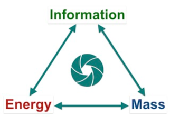
3. Energy is Transfer of Information : Energy and information are deeply linked, as physical information requires energy to be stored or transmitted, often described by the Landauer limit where erasing information releases heat (energy). While energy is not technically the sameas information, information cannot be transmitted or processed without energy. Experiments have demonstrated that information can even be converted into usable energy. https://www.google.com/search?client=firefox-b-1-d&q=energy+is+transfer+of+information
4. Bayesian Causation : The human brain constantly infers causation to navigate the world, transforming sensory correlations into predictive, causal models that drive behavior. It uncon-sciously uses Bayesian inference — combining prior knowledge with current sensory input — to determine if events are related, with critical computations occurring in the frontal lobe. https://www.google.com/search?client=firefox-b-1-d&q=causation+bayesian
Post 150 Continued . . . click Next
Holistic & Complex Systems The new properties that appear during a phase transition (e.g., the rigidity of ice versus liquid water's fluidity) are examples of emergence, where the collective behavior of a large number of particles results in system-level properties that individual particles do not possess. This concept is a fundamental aspect of complexity theory, which is mathematically compatible with a materialist and deterministic framework.
Complexity theory contrasts with determinism by showing that some complex systems can have emergent properties that are not reducible to the deterministic rules of their components, and these systems may not be predictable even if they are technically deterministic.. Determinism posits that all events are predetermined by prior causes, while complexity theory suggests that phenomena like consciousness and free will could emerge in complex systems where order and randomness interact



 BACK
NEXT
BACK
NEXT
 Forum
Forum